11/17/2025
Coin Control is the key that elevates you from a passive Bitcoin holder to an active financial steward.
Why You Must Master Coin Control Now: The Unseen Risk
If you believe securing your Bitcoin simply involves holding the private keys on a hardware wallet, you're missing a critical layer of defense.
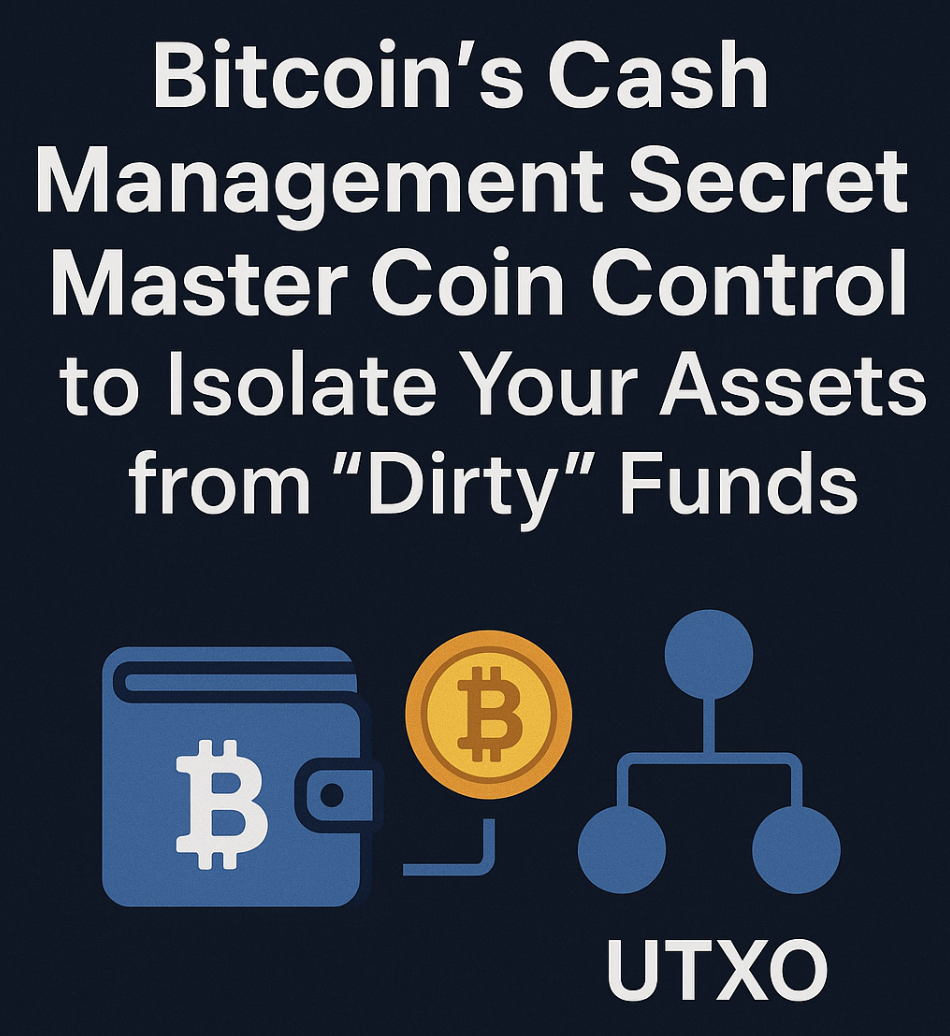
The digital balance displayed on your screen is deceptive. It’s not one clean figure; it's a culmination of numerous scattered transaction outputs—your digital cash stacks. The failure to manage these stacks is the #1 reason why clean, self-custodied Bitcoin can still be rejected or flagged by major centralized exchanges (CEXs).
The Core Problem: Your wallet software is a "Lazy Accountant," mixing clean funds with any small, potentially high-risk payments you receive. This commingling can result in your entire asset being designated as "tainted" by chain analysis firms, effectively severing your vital link to cash-out points.
Mastering Coin Control is non-negotiable for true financial sovereignty. It empowers you to enforce strict asset hygiene, maintain privacy, and manage your fees like an expert.
Part I: The UTXO Revelation—Your Bitcoin is a Pile of Cash Stacks
To understand Coin Control, you must first understand the UTXO (Unspent Transaction Output).
Imagine your Bitcoin wallet as a physical safe filled with various bills and coins from different transactions throughout the years:
- A payment you received from your employer (a $5,000 bill, or UTXO A).
- A small tip you received from a random website (a $5 coin, or UTXO B).
- A withdrawal you made from an exchange (a $10,000 bill, or UTXO C).
When you make a payment, your wallet's default setting is to grab the easiest combination of these bills to cover the cost, regardless of where they came from. Coin Control is the feature that allows you to open the safe and manually select which bills to spend.
Part II: The Critical Scenarios Where Coin Control is Essential
Mastering this skill protects you from major pitfalls and optimizes your transactions:
1. 🚨 Risk Isolation (Asset Hygiene)
This is the most crucial application. If a minor UTXO (say, 0.001 BTC) originates from a high-risk source (like a darknet market or a known hacker's address), it is considered "tainted."
- Coin Control Strategy: You explicitly tag this UTXO as “#quarantine” or “#risky.” When making a large withdrawal or payment, you manually deselect the tainted UTXO, ensuring your primary assets never merge with the high-risk money in a transaction. This keeps your main assets clean and acceptable to exchanges when you eventually need to sell.
2. 🤫 Privacy and Traceability
When you combine many different UTXOs (e.g., small mining rewards or numerous tips) into one large transaction to buy something (e.g., property), you effectively link all those unrelated historical addresses together.
- Coin Control Strategy: Experts use this feature to ensure that transactions use UTXOs from a single, dedicated source as much as possible. This prevents chain analysis firms from easily drawing a comprehensive map of your entire financial life and associating all your various sources of income.
3. 📉 Fee Optimization
Bitcoin transaction fees are based on the data size (or weight) of the transaction, not the monetary value. The more UTXOs you include, the larger the data size, and the higher the fee.
- Coin Control Strategy: During periods of network congestion, you can manually choose to spend fewer, larger UTXOs rather than many small ones. This significantly reduces the transaction’s data size, leading to lower miner fees and faster confirmation times.
Part III: Activating Expert Mode
While basic wallet interfaces (like many mobile or native hardware wallet apps) are designed for simplicity (the "Lazy Accountant" mode), your hardware device is compatible with more advanced desktop interfaces.
To gain access to your UTXOs and manage them manually, you need to connect your hardware wallet to specialized software.
- Example Tool: One popular and feature-rich desktop wallet favored by advanced Bitcoin users is Sparrow Wallet. It offers a clear, visual interface for UTXO management, allowing you to easily label, categorize, and select individual "coins" for any transaction.
⚠️ Essential Due Diligence Disclaimer
While tools like Sparrow Wallet are widely used in the Bitcoin community, you must exercise extreme caution whenever using third-party software with your hardware wallet.
We strongly urge readers to conduct their own due diligence (DYOR). Always verify software sources, check community reviews, ensure you download binaries only from official developer websites, and never, under any circumstances, input your seed phrase into any software that is not pre-installed on your hardware device. Your private keys must remain physically locked inside your device.
Conclusion:
Coin Control is the key that elevates you from a passive Bitcoin holder to an active financial steward. By enforcing asset hygiene, optimizing fees, and protecting your privacy, you are not just securing your Bitcoin—you are actively participating in the ethos of financial sovereignty. Don't let a "lazy accountant" put your hard-earned assets at risk.